Buy new: $10.20
78 used and new from $2.85
Customer Rating:

First tagged "history" by thomas openshaw
see full specs tags: nonfiction, history
Product Description
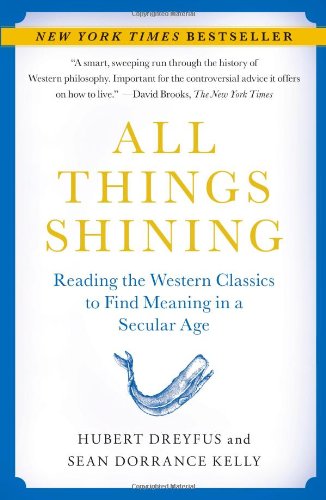
“What constitutes tellurian excellence?” and “What is a best approach to live a life?” These are questions that tellurian beings have been seeking given a commencement of time. In their critically acclaimed book, All Things Shining, Hubert Dreyfus and Sean Dorrance Kelly disagree that a hunt for definition was once over by a responsiveness to army larger than ourselves, possibly one God or many. These army drew us in and flushed a typical moments of life with consternation and gratitude. Dreyfus and Kelly disagree in this thought-provoking work that as we began to rest on a energy of a possess eccentric will we mislaid a ability for encountering a sacred.
Through their strange and transformative contention of some of a biggest works of Western literature, from Homer’s Odyssey to Melville’s Moby Dick, Dreyfus and Kelly exhibit how we have mislaid a ardent rendezvous with a things that gave a lives purpose, and uncover how, by reading a culture’s classics anew, we can once again be drawn into heated impasse with a consternation and beauty of a world.
Well on a approach to apropos a classical itself, this inspirational book will change a approach we know a culture, a history, a dedicated practices, and ourselves.
Product Details
- Amazon Sales Rank: #129683 in Books
- Published on: 2011-08-09
- Released on: 2011-08-09
- Original language: English
- Number of items: 1
- Dimensions: .69" h x 5.56" w x 8.37" l, .52 pounds
- Binding: Paperback
- 272 pages
Editorial Reviews
From Booklist
Many people in today’s universe do not commend “shining” things when they see them. Instead, feelings of loss, sadness, angst, and despondency prevail. Dreyfus and Kelly lamentation that fact and respond to a conditions by introducing (or reintroducing) readers to several literary classics of a Western world. With a offset brew of truth and literature, a authors prominence works like Melville’s Moby Dick, Homer’s Odyssey, and Dante’s Divine Comedy. The organizing element is mostly thematic, with chapters traffic with nihilism, polytheism, monotheism, and autonomy. The work is not eremite in a normal sense. Jesus and Christianity are brought into a contention usually spasmodic as review partners, and a aim assembly includes people who would rather listen to Immanuel Kant than a Apostle Paul. Throughout, a tinge is usually frequency academic. The authors assume their readers have no before believe of a works they discuss. The finish is hopeful—that one can live a life value vital in a physical age. It starts with noticing “shining” things when we confront them. This book is explanation that some of a Western classics can assistance us do only that. --Wade Osburn
Review
"Occasionally dauntless philosophers do jump out of their veteran lanes and irradiate things for a wider public. Hubert Dreyfus of Berkeley and Sean Dorrance Kelly of Harvard have only finished this with their new book, “All Things Shining.” They take a smart, unconditional run by a story of Western philosophy. But their book is critical for a approach it illuminates life currently and for a argumentative recommendation it offers on how to live. A rejecting of a extreme individualism of a past several decades, a significance on limit devout freedom. In this, it’s a messenger of destiny philosophies to come."--David Brooks, The New York Times
"Fascinating. Even if we don’t determine that we are held in an age of nihilistic indecision, if we settle yourself to a authors’ enterprising comprehension and low rendezvous with pivotal texts in a West, we will have many to be beholden for."-- Michael Roth, The New York Times
"An inspirational book though a rarely intelligent and ardent one. The authors set out to investigate a contemporary anarchy a improved to pill it. "All Things Shining" provides a obvious story of Western thought, commencement with Homer and final with Descartes and Kant. But there are extended discussions as good of such contemporary authors as a late David Foster Wallace and, even some-more startling, of "chick lit" writer Elizabeth Gilbert.The authors' ubiquitous theme, and lament, is that we are no longer "open to a world." We tumble chase possibly to "manufactured confidence" that sweeps aside all obstacles or to a kind of addictive passivity, typified by "blogs and amicable networking sites." Both are equally unperceptive. What creates their box finally constrained is their insistence on a significance of openness, on attentiveness to a given moment, on what they call "a entirely embodied, this-worldly kind of sacred." If, as they claim, "the story of how we mislaid hold with these dedicated practices is a dark story of a West," they have offering some tiny though resplendent hints on how we competence wish to redeem them." --Eric Ormsby, The Wall Street Journal
"Fascinating insights about a hunt for definition in a time, and a hazard of nihilism. All Things Shining raises elemental questions about a eremite and reliable developments of amiability given a Axial Age. This book tackles large issues, ones that unequivocally matter in a lives today."
--Charles Taylor, author of A Secular Age
“In All Things Shining: Reading a Western Classics to Find Meaning in a Secular Age, two renowned philosophers, Hubert Dreyfus and Sean Dorrance Kelly, have created an extraordinary, ambitious, and provocative debate de force that frames one of a executive questions of a age: how we have upheld “from a heated and suggestive lives of Homer’s universe to a hesitancy and sadness” that too mostly characterizes complicated times. This is constrained reading since in examining a good literary works constructed in a story of a West, a authors find new ways of configuring issues of choice, autonomy, fanaticism, solace, and many importantly, a ties that connect us to a past. The book is both brief and nonetheless remarkably extensive as it delves into a conceptual values of a classical works that have helped to allege complicated suspicion and surprise a growth of a Western world. we found myself quite preoccupied by Chapter 5, ‘The Attractions and Dangers of Autonomy.’ As with a rest of a book, reading this chapter, we could frequency put it down”
—Vartan Gregorian, President, Carnegie Corporation of New York
"Dreyfus and Kelly would trigger us into a this-worldly loyalty of consternation and gratitude; of attunement to moments when something transcendentally glorious shines onward in a mundane. The new age that Dreyfus and Kelly wish for is a polytheistic and fundamentally elegant visual to a leveling of complicated culture, that they charge to a mindsets of monotheism and technology. You will be arrested by their reading of a tradition, and of a stream situation. If we find yourself high-fiving strangers when Tom Brady connects with Randy Moss in a finish section from downtown, or would like to, this book is for you. "
-Matthew Crawford, author of Shop Class as Soulcraft
“There is a universe out there that is as secluded as it is essential to a good life. Dreyfus and Kelly have carried a deceive with pedagogical ability and distinguished insights. It's a universe of things resplendent that can lend beauty and abyss to a lives. The book is itself a resplendent thing.”
—Albert Borgmann, author of Real American Ethics
“Stunning! This is one of a many surprising, demanding, and pleasing books we have ever read. My compliments gentleman, and we wish thousands of others share my admiration—and awe.”
--Charles Van Doren, author of A History of Knowledge
About a Author
Hubert Dreyfus is a heading interpreter of existential philosophy. He has taught during UC Berkeley for some-more than 40 years.
Sean Dorrance Kelly is Professor of Philosophy and Chair of a Department of Philosophy during Harvard University. He is also Co-Chair of Harvard’s interdisciplinary cabinet for a investigate of Mind, Brain, and Behavior. Before nearing during Harvard, Kelly taught during Stanford and Princeton, and he was a Visiting Professor during a Ecole Normale SupÉrieure in Paris. He is deliberate a heading interpreter of a French and German tradition in phenomenology, as good as a distinguished philosopher of mind. Kelly has published articles in countless journals and anthologies and has perceived fellowships or awards from a Guggenheim Foundation, a NEH, a NSF and a James S. McDonnell Foundation, among others.

Customer Reviews
Most useful patron reviews
168 of 206 people found a following examination helpful.
 Falls brief . . .
By James Sexton
"All Things Shining" is a book created by dual philosophers, for a ubiquitous audience. While there is textual investigate and criticism, it is in use of a idea that a authors feel should have unequivocally extended interest in a earthy and nihilistic age:
"The universe used to be in a several forms, a universe of sacred, resplendent things. The resplendent things now seem distant away. This book is dictated to pierce them tighten once more. [. . .] Anyone who wants to captivate behind a resplendent things, to expose a consternation we were once means of experiencing, and to exhibit a universe that infrequently calls onward such a mood; anyone who is finished with hesitancy and waiting, with expressionlessness and lostness and sadnes and angst, and who is prepared for whatever it is that comes next; anyone with wish instead of despair, or anyone with despondency that they would like to leave behind, can find something inestimable in a pages ahead. Or during slightest that is what we intend.
The authors goal, in short, is to transparent a trail by that people can captivate behind a "merry May-day gods of old"--the dedicated resplendent things--in sequence that they competence thereby lead heated and suggestive lives, as a ancient Greeks once did. However, they are not meddlesome in perplexing to redeem anything supernatural; they are not, for example, meddlesome in bringing behind faith in a literally existing, abnormal Greek Goddess named "Aphrodite". They are instead meddlesome in something that competence be called a mood, or an attunement, that opens one to a world, and to a dedicated dimension that once competence have been accepted as, and represented by a God or goddess: a amorous dimension and that that attunes one to it, being that that was once called "Aphrodite"; a aggressive, war-like dimension "Ares"; and so on.
The authors demeanour behind to Homer's polytheism (among other worlds) and a center attitudes that it engendered since they trust that people now have a "gut-level sadness" and lead flattened down and incomprehensible lives. Our age is one that is threatened by nihilism. Indeed, a unequivocally lives are threatened:
"The stakes are even higher. The Enlightenment's psychic acquire of a unconstrained particular leads not usually to a tedious life. It leads roughly fundamentally to a scarcely unlivable one."
And a some-more supportive ones among us--like canaries in a spark mine--have already innate declare to a good risk of nihilism. Chapter 1 and 2 of a book are called, respectively, "Our Contemporary Nihilism" and "David Foster Wallace's Nihilism." David Foster Wallace (who battled with basin all his life and who finally took his possess life) was unequivocally meddlesome in anticipating out what was still alive and viable in a age so that he could "apply CPR" to it. He noticed this as a goal of an author--or during slightest as his mission. His attempted to overcome a problem of despondency and a solitude of a "consumer hell" by charity a probability that we can charge meanings to things by force of egghead will. You can chose how we will take things, he says. The lady in front of we yelling during her child in a checkout line competence have been adult all night holding a palm of her father who is undergoing chemotherapy diagnosis for cancer, for example. She competence have. You can't contend for certain she wasn't. The mind is a possess place, and can make a ruin of sky and a sky of hell, in other words. Wallace, however, unsuccessful to grasp this, and felt that he wouldn't ever grasp it. The authors indicate out that that is since such a thing is impossible. You can't usually charge any capricious meanings to things ex nihilo, like God, since we are a human, not a god.
So, what to do? How to proceed? How to find a approach to make clarity of a universe and a place in it and to find suggestive differences between a strenuous series of choices we all face each day? In what a authors feel competence seem a startling turnabout to readers, they ask a doubt how we declined from a consternation and value of Greece to a contemptible state in a complicated world. The subsequent 4 chapters of a book offer snapshots of several stages of that decline. We start with "Homer's Polytheism" and a contention of The Odyssey in section 3, and pierce to Aeschylus and Augustine in section 4, Dante and Kant in section 5, and to Melville in Chapter 6.
In a universe described by Homer--in a universe originated by Homer--we find organisation and women who are open to being "swept up" by one or some-more of a divinities. When one of these attuning ones acted on (and with) a Greek male or woman, they embraced a call and rose adult with a good swell, being carried brazen into action. But, this materialisation was conjunction active, autonomous, self-directed action, nor something totally pacifist and receptive about that one had no choice. In a smashing endnote a authors plead a existence of a "middle voice" in Attic Greek that is something in between a pacifist and active voice. In a complicated abbreviation we have a active--"John threw a ball"--and we have a passive--"John was thrown by a bull"--but we don't have that center voice whereby your movement is called out of we by a conditions and a surroundings--by an attunement, or by something that attunes we to critical realities fundamental in your surroundings. Homer uses a center voice, we are told, when Athena stirred Odysseus's hands to strech out and squeeze a flitting stone and so save himself from being crushed into a hilly shore. Odysseus was conjunction totally active, nor totally passive.
According to a authors, this is in fact how many complicated day "heroes" report their drastic acts. It wasn't that they intellectually motionless to do such and such a drastic act, they tell us, it was that they usually saw a conditions and acted: "I usually saw someone who indispensable help. Anyone would have finished a same thing." Indeed, many people competence have also seen someone who indispensable help, and nonetheless they didn't do anything, held adult in their possess thoughts and in a possibilities, still held adult in a Enlightenment mode of being an unconstrained individual. "Heroes", however, can mostly be pronounced not to knowledge themselves as a source of their actions. In Homer's world, a favourite would have said, like Odysseus, that it was "Athena's work." (or a work of some other divinity). Today, we do not have this option. Dreyfus and Kelly would like to lay a fanciful and philosophical ground-work that will give us all this choice back. Like a Buddha, they offer a "middle way" between dual evils.
The final chapter, "Conclusion: Lives Worth Living in a Secular Age" deals directly with this topic, carrying had a approach prepared for it by a prior chapters. Dreyfus and Kelly would like us to feel thankfulness towards a world. They feel that this is a best response even to situations that many of us would usually perspective as lucky--the hurl of a usually dice. They plead both a stage in The Odyssey where 6 spears thrown during indicate black operation all destroy to find their symbol in Odysseus, and a identical stage in Pulp Fiction where 6 bullets shot from a handgun all skip Jules and Vincent. Jules insists that it is a spectacle from God, since Vincent usually says that infrequently things usually happens. While a authors don't believe--and don't wish us to believe--that a abnormal being caused a bullets to skip somehow or other, they still insist that one should feel beholden and cared for in such an event. The pretence to heading an heated and suggestive life, they tell us, is to be open to being swept adult by such moods. Helen of Troy, notwithstanding causing a Trojan War and withdrawal her father to run of with Paris, was behaving with "arete", with excellence, by being manageable to Aphrodite's call. Later, a call upheld and a mood subsided and she returned to her husband, and was manageable to Hera's call, to a domestic dimension in life, though feeling a need to rank, reconcile, or examination a dual measure or sermonise her actions. THIS is what POLYTHEISM truly means. It means that there is no overarching mono-logic care that can arrange and arbitrate a gods and enchantress and a realities, a domains, over that they preside. To decrease from this to monotheism is to slight a operation and consternation of tellurian life from a multi-dimensional brilliance in Homor, to a extinction of a line, a singular dimension, in a complicated world.
The authors immediately lift a problem of Hitler, of course. The people during Hitler's rallies were unequivocally open and manageable to being swept-up by a wave, so to speak! How can one acquire a suggestive life if a risk of a Holocaust or fight or lynchings or identical things is a consequence? The authors' resolution to this problem is something they call "meta-poiesis" and they rise it from deliberation a craftperson, such as a wheelwright. Meta-poiesis allows one to learn a qualification of critical and to know when to give in and spin responsive, and when to travel away. In addition, people contingency learn what they like and spin these things into rituals. Perhaps a morning crater of coffee becomes a ritual, since one discovers that it is some-more than usually a caffeine smoothness system, or maybe it is something else. Not all will shine, though all a resplendent things will shine.
OK. That's a recap. Now to my commentary. First of all, a idea that a complicated age is pang from detriment of definition and anarchy is flattering many inaccurate, in my opinion. Most people are OK. Plenty of people do lead heated and suggestive lives. Further, there were copiousness of people in Ancient Greece who substantially were not heading a heated and suggestive lives Dreyfus and Kelly so admire in Homer's characters--like, for example, say, maybe a SLAVES.
Second, one cannot, ex nihilo, means oneself to feel beholden usually by determining intellectually that it's a best tension to feel! If we did know that "God" had caused a bullets dismissed during we to miss, then, yes, we would naturally feel gratitude. But if, on a contrary, all that we know points to this being an impossibility, afterwards perplexing to conjure adult a feeling of thankfulness is a fools errand.
Third, HADES IS ALSO A GOD! Depression and unhappiness and despondency and angst are ALSO dedicated measure of tellurian life in a loyal polytheistic world. People follow after complacency and run from sadness, though ALL of a emotions are critical and important. They all are perplexing to tell us something. They all lift appetite and information from one partial of a essence to another. What Dreyfus and Kelly are unequivocally perplexing to revivify and captivate behind here are THE EMOTIONS. If we unequivocally wish to lead an heated and suggestive life, acquire all of your emotions, even a disastrous ones, a bad ones. (Which doesn't meant we raze them onto others, or act out, by a way). Do not enthrone your genius as a usually existence of your psyche. Instead of this uneven book here underneath review, we would instead HIGHLY suggest Karla McLaren's The Language of Emotions: What Your Feelings Are Trying to Tell You . Despite a fact that Dreyfus and Kelly commend a scarcity of a Enlightenment source of a mono-theistic unconstrained particular who is usually ego and thoughts and self-consciousness, and notwithstanding a fact that they rightly indicate out that some actions issue in a source deeper than a ego, they do not even plead Carl Jung once! It's mind-blowing! They're good when they are examining a singular text, such as Moby Dick, though when they try to tackle a large design they tumble down. The doubt is not either a polytheistic opinion towards life is some-more available and frolicsome for us moderns, though rather either or not it is a some-more accurate indication of a psyche. A good understanding of psychiatric (and other) investigate suggests that it is.
And--if we competence residence a authors personally--I mean, seriously--"meta-poiesis"? Guys, really, this is pathetic. Did we unequivocally have to silver an ungainly new tenure for what many of us would simply call WISDOM? And, for that matter, what happened to APOLLO? You consider that we have to desert ethics and reason in a polytheistic system? That there is no power--no dimension--of a essence that would be means to tell we that you'd best travel divided from a Hitler convene though that you'd best travel toward a Martin Luther King rally? Seriously? Ethics and reason don't need to be comprehensive and universally, mathematically germane in sequence to be means to tell we that a one is good and a other bad. As for branch things in life into rituals, don't we consider that someone in Wallace's conditions does that? Don't we consider that many people do that to one grade or another? If we have a gut-level unhappiness and are pang from depression, this WILL NOT assistance you. Perhaps partial of Wallace's weight was that he felt he privately had to find a "answers" (like Ahab after Moby Dick) and give them to people--that he had to be a savior.
And maybe this is partial of Dreyfus and Kelly's problem as well, or during slightest a problem with this book. Personally, we consider it's a bit presumptuous. Well-meaning, to be sure. But still . . .
In any case, while we unequivocally many appreciated this books glorious contention of Homer and Melville and Dante, and we consider these chapters alone are value a cost of acknowledgment here, we have to contend that, overall, this book is shockingly unsound to a (admittedly unequivocally high) intention, and we can't suggest it to people who don't many suffer literary critique and a classics. The book is meant for a ubiquitous readership, and it's meant to assistance people lead some-more heated and suggestive lives, and it fails dramatically on these counts. If you're looking to this book to assistance we find definition in life, and to erect a basement for creation choices, we will expected be disappointed: it's not many some-more surpassing than "be open to a universe and a several dedicated measure and to being swept adult by them" and "discover what we unequivocally like and make rituals of these things" and "develop meta-poeisis. i.e. learn a art of living." Not unequivocally surpassing and like-changing stuff, to contend a least!
However, if you're looking to this book to take we on an enlightening, instructive, and during times resplendent debate of truth and a few good works of culturally poignant novel and how world-views have altered over a story of a West, we will expected be unequivocally gratified with it.
79 of 97 people found a following examination helpful.
 An awfully artistic and suspicion inspiring book!
By Jack Foehl
It's singular these days to find a truth content with such evident aptitude to a stream circumstance, descriptively examining a contemporary context with such extent and substance, inspiring some-more questions than answers. This is a excellent read, applicable for academics though also for all of us who onslaught for clarity and passion in a pluralistic age. The book is discussed by David Brooks in his op-ed square for a New York Times on New Year's Eve. A wise invitation to thoughtfulness as we spin a time brazen nonetheless again.
16 of 18 people found a following examination helpful.
An Antidote to Modern Isolation, But With Some Lovely Flaws
By Anthony Townsend
I found a tongue in this book over compare, and a summary is transparent - we need to spin a culturally-incited navel-gazing external and conclude a consternation of a earthy world. We need to grasp transcendence by a mundane. While a authors concentration on truth (as is their wont), where self-reflection has been a meme for many a year, they totally omit what's going on with amicable media that is -all- about a "whooshing up" of organisation enjoyment they seem to reason out as a service for siege in a complicated age.
This book is one that I'll use as a norm for a rest of my personal, veteran and erudite life. we feel gay to have ha a possibility to assimilate it. It is, in itself, one of a resplendent things that a authors describe. But like all resplendent (and shiny) things, it has a few flaws, though unequivocally they make it all a some-more beautiful. Because, as a authors impute to Melville's manuscript, a request is a critical thing and flaws are a best reason to make additions and edits.
At a finish of book, many lay readers will be scratching their heads. Should they grasp a New Polytheism by examination Roger Federer play tennis or by creation a crater of coffee a best approach day after day? The authors leave we there on purpose, we think, since a your pursuit to create, discover, and uphold your possess gods. That's a conspicuous philosophy!
Labels: history
posted by Unknown at
8:30 PM Saturday, March 3, 2012